Verify Collision Repair Quality With Five Evidence Gates
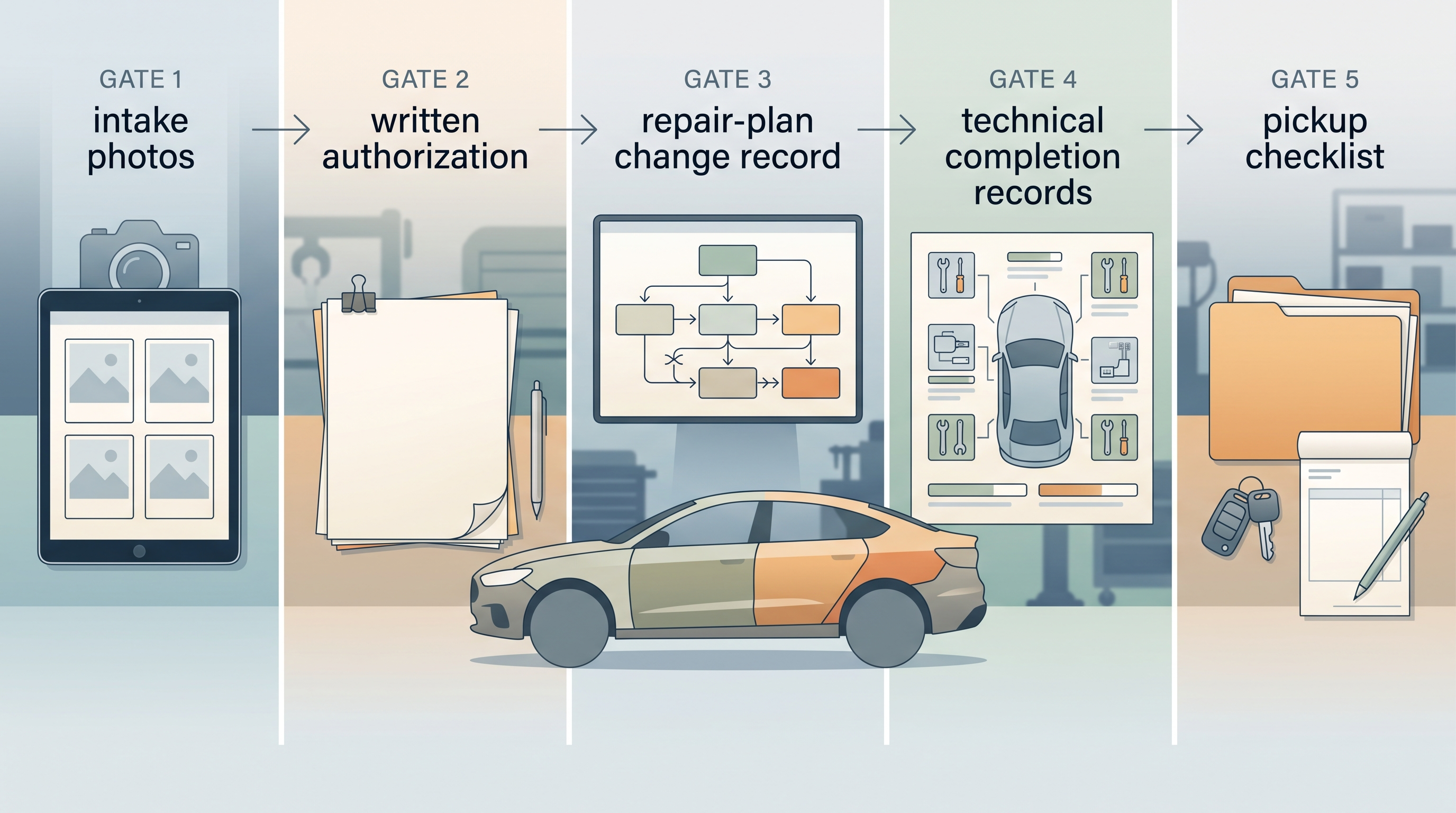
A driver evidence and handoff guide
Verify Collision Repair Quality With Five Evidence Gates
Short answer. A useful collision repair quality checklist does not try to certify hidden work from a walk-around. It creates five evidence gates: intake baseline, written authorization, change control, technical completion and pickup. At every gate, identify the applicable record, who owns the answer and what would stop the repair from moving forward. Ask the repairer to explain vehicle-specific work and keep the final documents together.
Quality review is stronger when each repair handoff leaves a clear record and unanswered questions stop the next step.
Know what this checklist can and cannot prove
A clean panel gap, smooth paint finish or quiet test drive can be reassuring, but none proves that concealed structure, restraints, sensors, electronics or driver-assistance systems were repaired correctly. A driver is not expected to inspect technical work. The practical job is to make the repair plan and its changes traceable, then ask the qualified repairer or relevant specialist to explain what applies to the vehicle.
The checklist is therefore built around evidence rather than certainty. An applicable record might be an estimate, work authorization, supplement, parts line, measurement, scan record, calibration record, alignment result, invoice or repairer explanation. Not every repair needs every record. The key question is: “What evidence applies to this operation, and how does it connect to my final invoice?”
A1 Buller Auto Collision publishes local collision-repair and contact context. Its current procedures, credentials, insurer relationships, warranties, parts policies and repair documents should be confirmed directly for the actual vehicle.
Gate one creates an intake baseline
Before disassembly or repair, record the vehicle, mileage, warning lights, visible damage, unrelated marks, personal-property handoff and any driving symptoms. Save claim or contact numbers, towing information and the names of people authorized to receive updates. Photograph visible areas from useful distances without entering an unsafe roadway or interfering with emergency response.
ICBC's post-crash guide provides British Columbia drivers with practical crash-information steps. The intake file should not speculate about fault or hidden damage. It should preserve what was observed and what was reported.
Stop condition: pause the handoff if the vehicle identity, damage area, warning lights, authorization contact or personal-property record is wrong. Correcting the baseline now is easier than resolving a disagreement after work begins.
Gate two connects authorization to a repair plan
Ask for the current estimate or repair plan in understandable sections. Identify what is confirmed, what remains subject to disassembly and who can authorize additional work. Discuss parts terminology, outsourced operations, insurer involvement, deductible or customer-pay items, and how approvals will be documented. Do not assume that an initial estimate is the final scope.
ICBC's explanation of damage estimates notes that additional damage can be identified as repairs progress. That is why the authorization gate needs a communication method, not just a starting total.
- Match the vehicle and damage area to the document.
- Separate approved work from provisional or diagnostic work.
- Ask who may approve a supplement and by what method.
- Identify customer-pay choices before they are performed.
- Keep the version that was actually authorized.
Stop condition: do not authorize language you do not understand. Ask for the disputed line, assumption or responsibility to be explained in writing.
Gate three controls repair-plan changes
A repair can change after parts are removed, measurements are taken or systems are assessed. Change itself is not the quality problem; an undocumented change is. For each supplement, connect the newly identified condition to the revised operation, parts, time, approvals and expected effect on completion. Ask whether the change affects an outsourced task, scan, calibration, alignment or inspection.
Keep one change log with the date, version, reason, approver and open question. If a part or operation is substituted, ask what changed and why. Avoid deciding technical equivalence from a short label; request the repairer's vehicle-specific explanation.
Stop condition: pause when completed work, the latest repair plan and the authorized scope do not reconcile. Resolve the mismatch before pickup rather than relying on memory.
Gate four requests applicable completion evidence
Near completion, ask the repairer to identify which technical checks applied and which records can be provided or explained. The list may include measurement, wheel alignment, pre- and post-repair scanning, calibration, glass work, corrosion protection, restraint-related work, mechanical diagnosis or a sublet invoice. Applicability varies by vehicle, damage and procedure.
Do not convert a missing document into an accusation. First ask whether the operation applied, who performed it, what result was reviewed and how it appears in the file. If a safety-related question remains unresolved, seek clarification from the repairer, insurer where applicable, vehicle manufacturer information or an appropriately qualified specialist before driving.
Stop condition: do not treat a visual walk-around as a substitute for unresolved technical evidence. Ask for the issue to be documented and for a safe next step.
Gate five makes pickup a controlled handoff
Compare the final invoice with the latest authorized plan. Review the repaired areas in suitable light, confirm accessible features and check the dashboard before leaving. Look for obvious finish or fit concerns, loose trim, new warning lights, unexpected noises, missing belongings or cleanliness issues. These observations can start a conversation; they do not diagnose concealed work.
Ask for care instructions, limitations immediately after refinishing, warranty terms if offered, receipts, records and the contact for a concern discovered later. Confirm what to do if a warning light appears or the vehicle behaves differently. A repairer should have the opportunity to inspect a reported issue, but urgent safety concerns require an appropriately cautious response.
Stop condition: if a warning, control issue or safety concern is present, do not assume the vehicle is ready. Ask the repairer to assess and document the next step.
Use one evidence matrix for all five gates
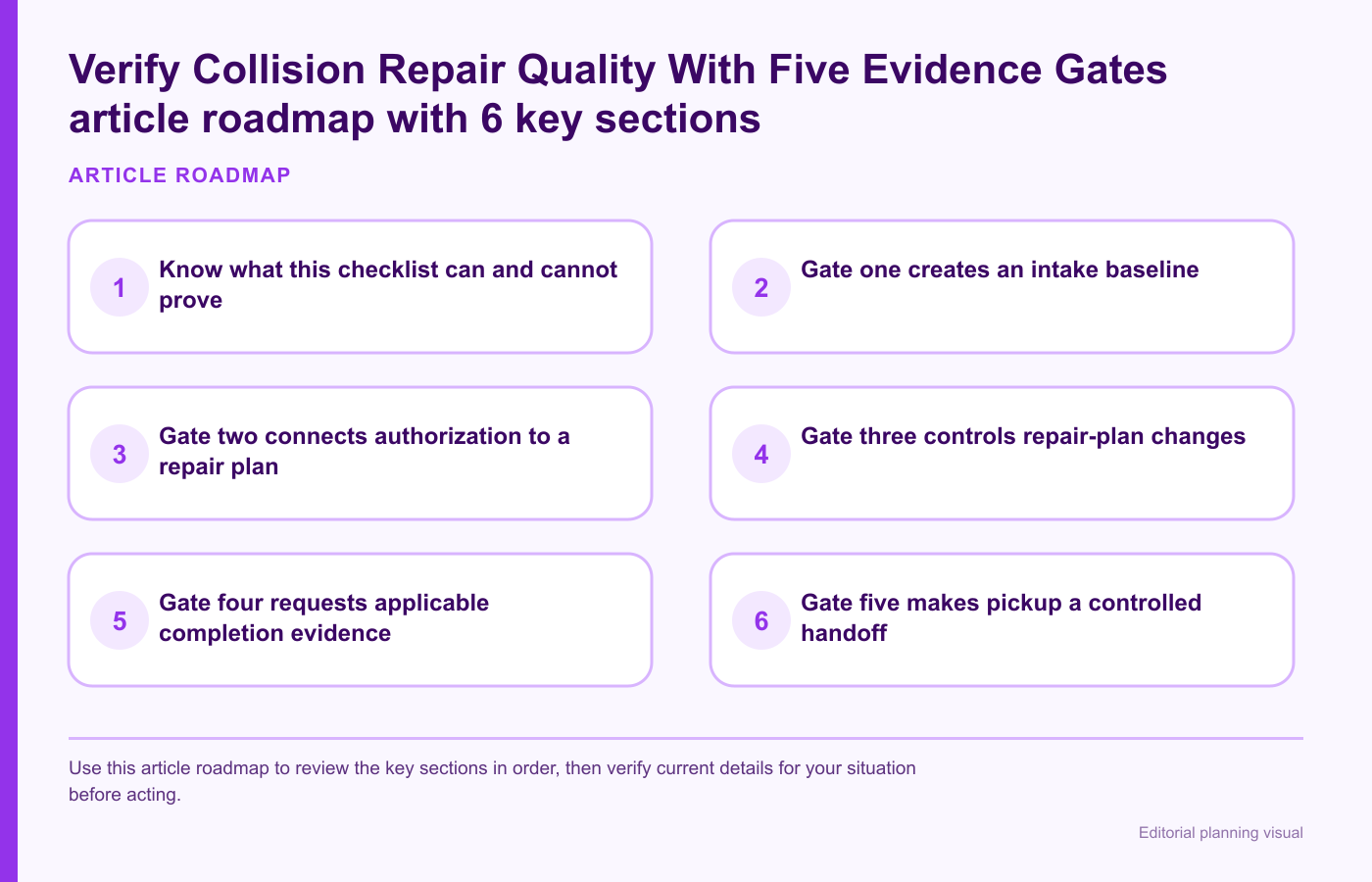
Use this article roadmap to review the key sections in order, then verify current details for your situation before acting.
| Gate | Evidence to discuss | Verification question | Pause when |
|---|---|---|---|
| Intake | Condition, warnings, contacts and photos | Is the baseline accurate? | Vehicle or damage details are wrong |
| Authorization | Estimate, scope and approval path | What is confirmed versus provisional? | A material line is unclear |
| Change control | Supplements and version history | Why did the plan change? | Work and authorization do not match |
| Completion | Applicable technical records | What checks applied and who reviewed them? | A safety-related answer is unresolved |
| Pickup | Invoice, walk-around and aftercare | What should happen if a concern appears? | A warning or control concern remains |
Common collision repair review mistakes to avoid
- Using appearance alone to declare hidden work safe or complete
- Failing to save the authorized repair-plan version
- Discussing a supplement verbally without recording the decision
- Demanding every possible record without asking whether it applies
- Assuming an insurer, repairer and driver own the same decisions
- Driving away with an unresolved warning or safety concern
- Inventing warranty, parts or certification expectations from old marketing
Frequently asked questions
Can I tell whether collision repairs are safe by looking?
No. A walk-around can identify visible concerns, but it cannot verify concealed structure, electronics, restraints or calibration. Ask what technical checks applied.
Should the final invoice match the first estimate?
Not necessarily. Additional damage may be found. The useful test is whether changes are explained, authorized and reflected in the final documents.
Do all collision repairs need calibration records?
No universal answer applies. Ask which vehicle systems and repair operations were involved and whether calibration or other checks were required.
What should I do if a warning light is on at pickup?
Raise it before leaving. Ask the repairer to assess it, document the explanation and give a safe next step.
Request a documented collision repair next step
Use the five gates to prepare the questions that apply to your vehicle. Read A1 Buller Auto Collision's published collision repair process overview, then contact the business to request the current repair plan, communication path and applicable evidence. Confirm every vehicle-specific detail before authorizing work or accepting pickup.